
A robot mother is being created in China: now machines will be able to give birth to children.


In China, serious consideration is being given to creating a robot that can carry and deliver babies . Kaiwa Technology, a company based in Guangzhou, China, is developing a machine with an artificial womb embedded directly into the “belly” of a humanoid device. The robot is slated to hit the market as early as 2026 and will cost approximately $14,000 (1 million rubles) . The news immediately sparked a flurry of discussion: some see it as a way to ease difficult pregnancies, while others point to moral risks and questions humanity isn’t yet ready to address.

A robot with an artificial womb
China has decided to go further than anyone else and aim to create the world’s first robot capable of carrying human children. The project was presented by Kaiwa Technology, and its founder, Zhang Qifeng, has already promised to unveil a prototype by 2026.
According to the developers, it will be a life-size humanoid with an artificial womb inside . The price promises to be “affordable”—around 1 million rubles in our money. The idea sounds impressive, but honestly, my first thought was, “Are you serious?! “
How a robot capable of giving birth works
According to Chinese engineers, the robot should completely replicate the pregnancy process, from conception to birth . A special fluid simulating amniotic fluid is infused into the artificial uterus, and the embryo is nourished through a tube, just like in a natural pregnancy. The scientists claim that the technology itself has already been tested on animals in laboratories, and now they plan to integrate it into the machine, allowing humans to literally “communicate” with the unborn child as it develops in the robot’s womb.
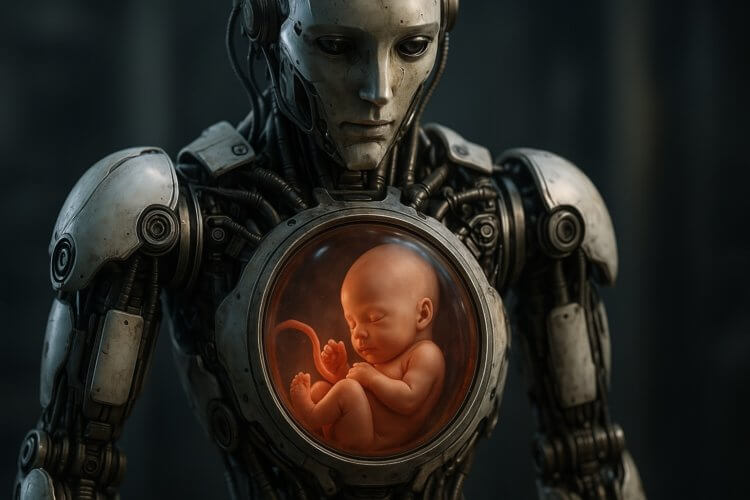
It sounds futuristic, but there are more questions than answers. For example, who will regulate such “pregnancies” and how, what will the laws say, and is society ready for machines to deliver babies ? In China, they claim legal discussions are already underway, but no details have yet been released about how the ethical issues will be resolved. It’s hard to imagine such projects being implemented without significant controversy and protests.
Artificial birth of children
There’s also purely scientific skepticism. So far, artificial wombs can only function in real-world conditions as incubators for premature babies—for example, in 2017, a lamb equivalent to 23 weeks of pregnancy was successfully raised in the US . But no one has yet succeeded in completing the process from fertilization to birth in humans. Technically, the Chinese project appears more like a statement of intent than a ready-made solution.
Meanwhile, the very idea of artificial reproduction is gaining momentum in China. They’ve already unveiled the world’s first AI-powered plant-crossbreeding robot , which accelerates the development of new varieties. Combining biotechnology and machines could create a whole new industry.







Comments are closed.